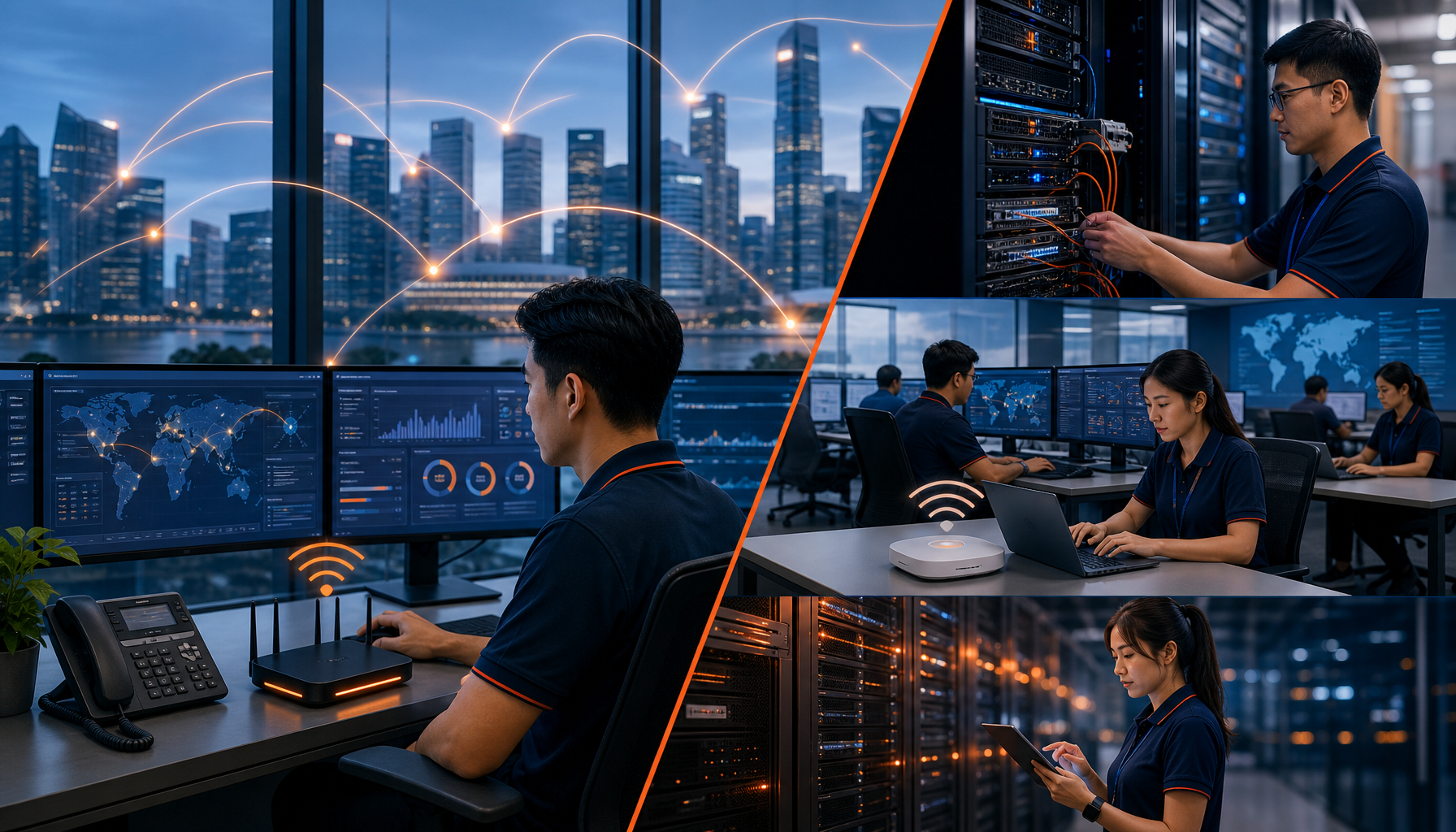
Remote hands support is a service where a local on-site technician carries out physical IT tasks at a data centre or office on behalf of a team that cannot be there in person. For APAC IT managers overseeing sites in Singapore, Jakarta, Manila, Bangkok, Ho Chi Minh City, Tokyo or Seoul, remote hands support removes the need to fly engineers across borders for routine or urgent on-site work.
The operational pressure is familiar: a switch goes down at your Bangkok office at 11pm local time, your nearest IT staff are in Singapore, and the site has no local IT headcount. Flying someone in the next morning means half a business day of outage. Using a local remote hands support provider means the issue gets resolved overnight.
What Does Remote Hands Support Actually Cover?
Remote hands support typically covers physical tasks that require someone to be present at the rack, server room or office floor. This includes cable swaps, device reboots, hardware replacements, visual inspection of indicator lights, patching ports, and escorting equipment deliveries. It is distinct from remote management, which is software-based access to a live system.
A common pattern across the region is that APAC offices are provisioned with networking and compute hardware but have no dedicated IT person on site. Remote hands support fills that gap without adding permanent headcount. For tasks that go beyond physical intervention, Servcom’s IT support services can extend to full troubleshooting and resolution.
When Should You Use Remote Hands Instead of Flying an Engineer?
The cost calculation is straightforward. A return flight, hotel and ground transport for an engineer from Singapore to Manila or Jakarta can easily exceed USD 1,500 before you factor in the time lost in transit. Remote hands support at the same site costs a fraction of that for a single call-out, and the technician can be on-site within hours rather than the next morning.
Most IT teams find that remote hands support makes commercial sense for any physical task that does not require the deep system knowledge of a senior engineer. Hardware swaps, structured cabling adjustments, equipment staging and basic rack work all fall into this category. The Servcom smart hands services page outlines the scope of what a trained local technician can handle under remote direction.
How Does Remote Hands Support Work in Practice?
A remote hands engagement typically follows a defined workflow. Your team raises a ticket or calls in the request, specifying the site, the task, and any access or safety requirements. The local technician attends site, confirms the task scope with your team remotely, carries out the physical work and provides a completion report with photos or video confirmation where required.
The quality of the outcome depends heavily on the briefing. Clear task descriptions, accurate rack diagrams and pre-shipped replacement hardware reduce the chance of a second visit. For larger or more complex deployments, pairing remote hands support with structured IT project management ensures all logistics, scheduling and vendor coordination are handled centrally. The Cyber Security Agency of Singapore also recommends that any vendor given physical access to IT infrastructure operates under a documented access control policy — worth building into your remote hands engagement process.
Frequently Asked Questions
Is remote hands support the same as smart hands support?
Remote hands support and smart hands support refer to on-site physical assistance, but smart hands typically implies a higher skill level — the technician can follow guided troubleshooting steps, make configuration-level decisions under direction, and handle more complex tasks than simple cable swaps or reboots. The terms are often used interchangeably by vendors, so always confirm the technician’s skill scope before engaging.
Can remote hands support cover multiple countries in APAC?
Yes, provided your vendor has a regional network of local technicians. A single vendor covering Malaysia, Singapore, Indonesia, the Philippines, Thailand, Vietnam, Japan and South Korea allows you to manage all remote hands support requests through one point of contact, which simplifies billing, reporting and escalation. This is particularly valuable for IT managers overseeing more than four or five countries simultaneously.
What information do you need to provide before a remote hands visit?
At minimum, you need to supply the site address and access instructions, the rack location or specific equipment involved, a clear description of the task, and any parts or replacement hardware to be pre-positioned. If the site is a third-party data centre, you will also need to arrange a formal authorisation letter for the technician. The more detail provided upfront, the less likely a second visit becomes necessary.
Servcom Solutions covers remote hands support across Malaysia and key APAC markets including Singapore, Indonesia, Philippines, Thailand, Vietnam, Japan and South Korea. For IT and facilities managers who need reliable local hands at sites where permanent IT staff are not present, Servcom offers a single regional point of contact. Find out more or discuss your requirements at www.servcom.my/contact.