
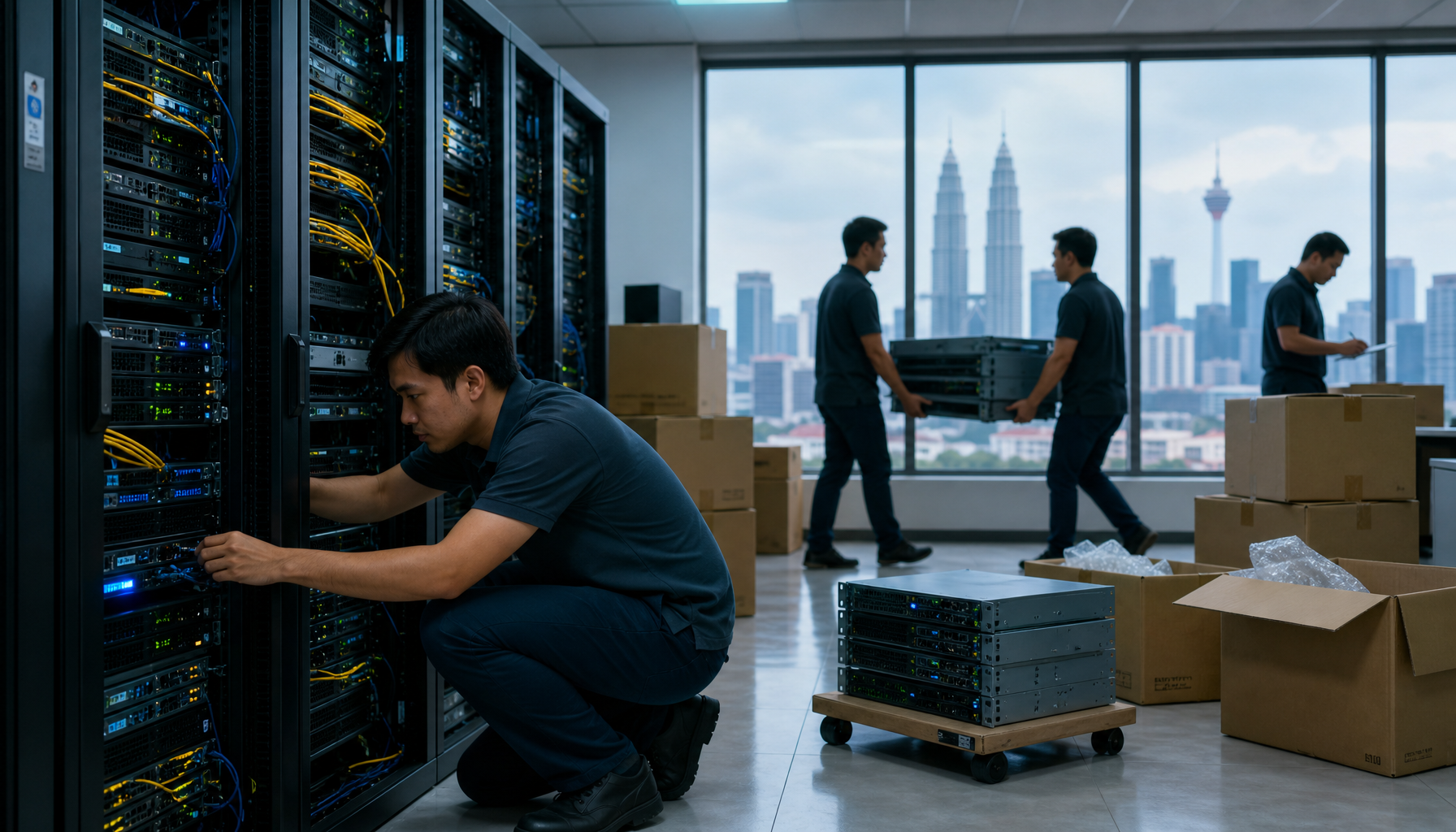
Picture this: a growing company in Shah Alam decides to move its server room as part of an office renovation. The plan looks straightforward on paper. A few racks get shifted, cables get reconnected, and everyone goes back to work on Monday morning. By 9am, half the office cannot access the shared drive, the accounting system is throwing errors, and the phone lines are down. What seemed like a weekend job turns into a three-day scramble.
Server room relocation is one of the most underestimated IT projects in Malaysian SMEs. It comes up more often than you might expect, particularly during office moves, lease renewals, or building upgrades. The physical side of the work looks manageable. The technical coordination underneath it is where things consistently go wrong.
Understanding the common patterns behind these failures can help you plan far more carefully the next time your business faces a similar move.
Server Room Relocation Planning: Why the Timeline Always Gets Compressed
A common pattern across Malaysian SMEs is that server room moves get attached to a broader renovation project, which means the IT timeline gets dictated by the contractor’s schedule rather than by what the IT environment actually needs. Cabling, cooling, and power requirements are often left until the last week. When the electrician and the IT team are trying to work in the same room at the same time, something always gets missed.
Proper planning for a server room relocation should start at least six to eight weeks ahead of the physical move date. That window is needed to audit existing equipment, document the current network topology, order any new cabling or hardware, and arrange for a test environment if the systems can afford one. Most IT teams find that the documentation step alone reveals surprises — unlabelled cables, undocumented IP addresses, or ageing switches that were never replaced because they had always ‘just worked’.
Power and Cooling Are Not an Afterthought
Server rooms in SME offices across KL, Petaling Jaya, and Johor Bahru are often improvised spaces. A repurposed storeroom with a wall-mounted air conditioner is more common than a purpose-built data room. When that setup moves to a new location, the assumption is often that the same arrangement will work again.
In practice, cooling and power need to be reassessed against the actual load. A server rack drawing consistent power in a poorly ventilated room will hit thermal limits faster than expected, especially in Malaysian ambient temperatures. A dedicated precision cooling unit or at minimum a split unit positioned correctly is not optional for a room running active servers. Power conditioning matters too. Uninterruptible power supply units need to be correctly sized, and their battery health should be verified before the move, not after.
Network Reconfiguration During a Move
The network layer is where server room relocation tends to produce the most persistent problems. IP addressing, VLAN configurations, and firewall rules that worked in the old location do not automatically translate to the new one. If the new room is on a different floor or a different building wing, the switch uplinks, fibre runs, and patch panel assignments all need to be replanned from scratch.
A common oversight is assuming that the physical move is the whole job. The configuration work often takes longer than the physical move itself. DNS settings, DHCP scopes, and any static routes configured on the old infrastructure need to be verified and sometimes rebuilt. For businesses running cloud-connected systems, VPN tunnels and authentication settings tied to the old IP range may also need updating. Guidance on secure network configuration practices is available from the Malaysian Communications and Multimedia Commission, which publishes resources relevant to business network environments.
Testing Before You Go Live
Most IT coordinators know they should test before declaring a migration complete. In practice, testing gets cut short because the business is waiting to resume operations. A structured pre-go-live checklist covering core services, user authentication, backups, and connectivity to critical systems takes an hour or two but prevents the kind of Monday morning crisis described at the start of this post.
Testing should include confirming that automated backups are running to the correct destination, that monitoring tools are capturing the new device addresses, and that remote access tools still connect correctly from outside the office.
Frequently Asked Questions
How long does a typical server room relocation take for a small Malaysian business?
For an SME with a modest server environment, the physical move itself can be done over a weekend, but the full project including planning, cabling, configuration, and testing typically spans four to six weeks when managed properly.
Do we need a professional IT team for a server room move, or can our internal staff handle it?
Internal staff can handle parts of the process, but server room relocation involves structured cabling, power assessment, and network reconfiguration that benefit from experienced hands. Mistakes made during a move are often harder to diagnose and fix than mistakes made during day-to-day operations.
What is the biggest risk of a poorly planned server room relocation?
Extended downtime is the most immediate risk. Beyond that, data loss from interrupted backups or corrupted storage during the move, and security gaps from misconfigured firewalls, are the issues that tend to surface days or weeks after the move when no one is looking for them.
If your business is planning an office move or a server room upgrade anywhere in the Klang Valley or across the region, Servcom Solutions in Shah Alam has the experience to help you plan and execute it without the Monday morning crisis. Reach out at www.servcom.my/contact.