
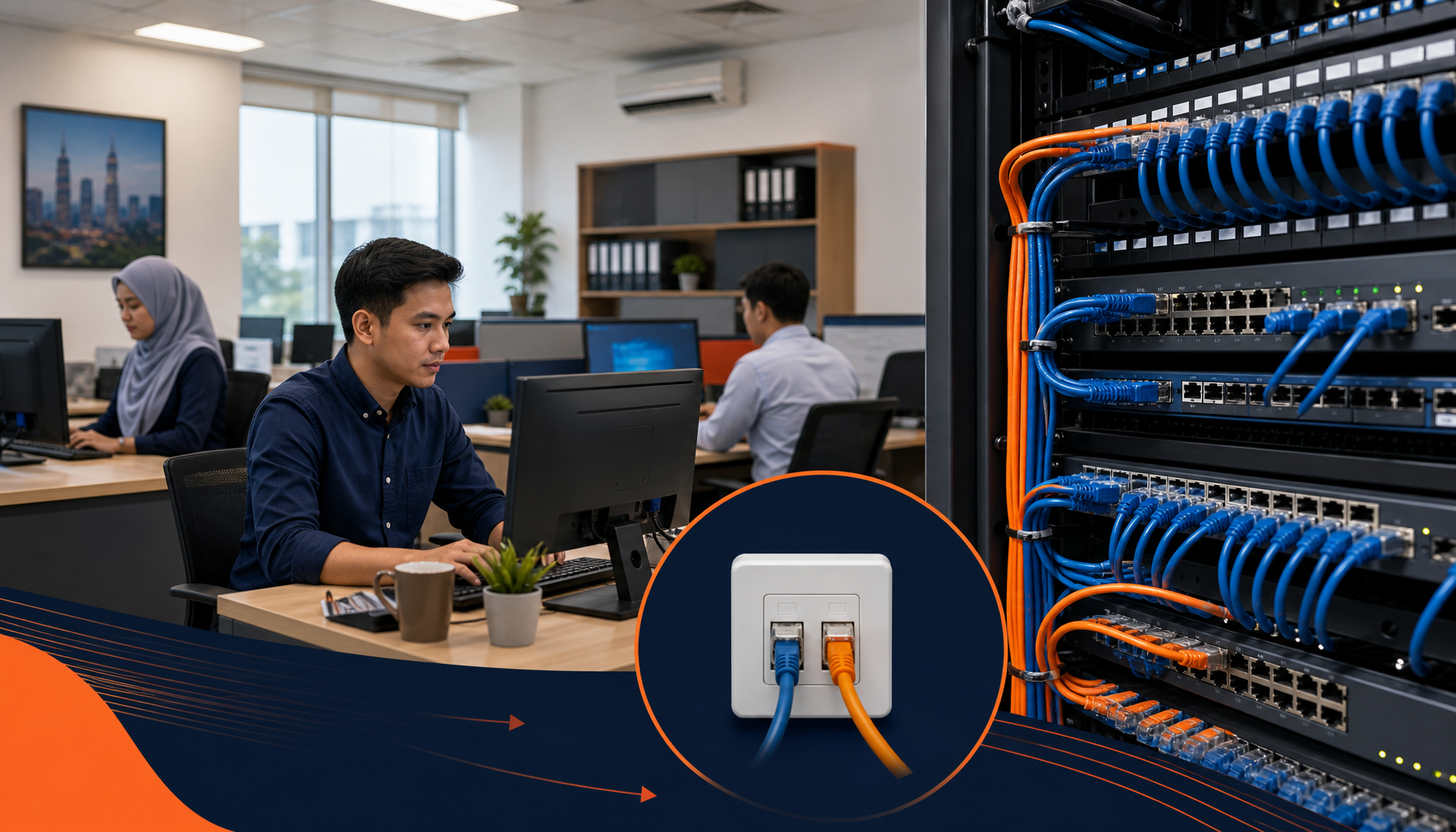
Structured cabling is the physical wiring system that connects every device in your office — computers, phones, printers, servers and network switches — to a central point. A properly designed structured cabling setup gives your business a stable, organised network that can grow with you without requiring a full rewire every time something changes.
Many small and medium offices in Malaysia still rely on ad-hoc wiring — cables run wherever was convenient at the time, with no documentation and no clear structure. It works until it does not. When a port fails, nobody knows which cable goes where. When you add new workstations, there is nowhere clean to connect them. When you move offices, the whole mess has to be unpicked from scratch.
This is the kind of problem that structured cabling is specifically designed to prevent. Understanding what it actually involves — and when your business genuinely needs it — can save you a lot of avoidable disruption down the line.
What Does Structured Cabling Actually Cover?
Structured cabling refers to a standardised, planned wiring infrastructure that supports multiple types of data and voice systems through a single, consistent layout. It typically includes horizontal cabling runs from a central patch panel to wall ports at each workstation, a rack or cabinet to house the patch panels and switches neatly, and labelled cable management so every connection is traceable.
In a typical Malaysian SME office — whether in Shah Alam or Subang Jaya, or a shophouse unit in KL — structured cabling usually means Cat6 or Cat6A copper cabling rated for Gigabit or 10-Gigabit speeds. The right cable category depends on your current equipment and how much headroom you want for future upgrades. A qualified installer will assess your floor plan, calculate cable runs and identify where your main distribution point should sit.
How Does Structured Cabling Differ From Just Running Ethernet Cables?
The difference is planning and standards compliance. Anyone can run an Ethernet cable from point A to point B. Structured cabling follows recognised standards — such as those outlined by MCMC and international bodies like TIA-568 — so that your network infrastructure is predictable, testable and scalable.
When structured cabling is done properly, every cable is tested end to end, every port is labelled, and a cable schedule is handed over to you as documentation. That documentation is what allows a technician — whether it is your own staff or an outside engineer — to diagnose a fault quickly without tracing cables by hand across a suspended ceiling.
Unplanned cable runs have no such traceability. Faults take longer to find. Upgrades require more disruption. And when you eventually move offices, you have no baseline to work from.
When Does an SME Actually Need Structured Cabling?
Structured cabling is worth investing in at a few distinct moments. The most obvious is a new office fit-out, where you have a blank space and the opportunity to do it right from the start. The second is when your current wiring is clearly causing problems — slow speeds on wired connections, intermittent drops on specific ports, or a patch panel that nobody can make sense of.
The third moment — and one that comes up regularly — is an office IT relocation. Moving to a new premises is the natural point to reassess your wiring entirely. Trying to move old ad-hoc cabling into a new space just recreates the same problems in a different building. A relocation is a practical opportunity to deploy a clean, documented structured cabling layout from day one in the new office.
Frequently Asked Questions
How long does a structured cabling installation take for a small office?
For a small office of 10 to 30 workstations, a structured cabling installation typically takes one to three days depending on the complexity of the floor plan and the number of cable runs required. Installations are often scheduled over a weekend to avoid disrupting business hours.
Does structured cabling work for WiFi networks too?
Yes. Wireless access points still require a physical wired connection back to the network switch, and structured cabling provides exactly that backbone. A well-cabled office makes it straightforward to position access points where coverage is needed, without improvised cable runs across the ceiling.
Can structured cabling support future upgrades like faster internet or VoIP?
Cat6 and Cat6A cabling supports speeds well beyond what most SMEs currently use, so a properly installed structured cabling system gives you considerable headroom. Upgrading your internet plan or adding a VoIP phone system typically requires no rewiring — just a switch or hardware change at the patch panel.
If your office wiring is overdue for a proper structured cabling review, Servcom Solutions in Shah Alam provides structured cabling installation and IT support services for SMEs across Malaysia. Visit www.servcom.my or get in touch with the team to discuss what your office actually needs.